Sunday, 18 January 2015

The Imitation Game

I would like to share with you my impressions after watching The Imitation Game. I really like movies based on the true story so for a Friday evening I chose just this one.
The plot is based on the story of deciphering German machine used during World War II which was called Enigma. The main chacaracter Alan Turing, who is a mathematician and cryptographer, helps crack the Enigma code. He has his own vision which leads him to construct an innovative machine which will be able to demystify the working of Nazi's Enigma.

In the background of this engrossing story appears another thread that concerns the homosexuality. After the war Alan Turing was prosecuted for homosexual relations and impelled to undergo a hormonal therapy and thereby he committed suicide. In the old days homosexuals were jailed in England. Some of them could choose to take hormons instead of imprisonment. Despite Turing's enormous contributions to the war he had to suffer due to intolerance.

I appreciate the way in that two topics were presented in the movie. The thread of deciphering the Enigma reflects clearly the main facts of its history. When it comes to the second topic, they put it in a particular framework and present it in a gentle way nonetheless, straight from the shoulder. 

If you haven't had a chance to see it yet, I highly recommend it.


The only source of knowledge is experience. 
Albert Einstein

Monday, 12 January 2015

What are your New Year's resolutions?

I used to getting started New Year with a shorter or longer list of resolutions. Lose weight, read more, do not waste time ecc. New Year's drive usually evaporated after two weeks and at the end of January all resolutions passed into a history. 

This year I decided not to make it more. This doesn't mean that I don't want to turn my life around. It means that I prefer develop some good habits not by making the list but through a hard work. The desire to fill the time which I got is the best motivation. I try to thine own self be true. 


And you? Do you make New Year's list of resolutions? 

Wednesday, 19 November 2014

wise help

I'd like to apologize, first of all, to my all readers for a long absence from my blog. I  have a hot time in my voluntary work now and I spend every free moment making sure that everything is prepared down to the last detail. 

picture comes from www.szlachetnapaczka.pl
I have been working in the "Wiosna" association for several years. This year I was chosen to lead a group of volunteers who are preparing project called "Szlachetna Paczka". This pre-Christmas compaign is based on the idea of wise help. What does it mean? "Szlachetna Paczka" is a project of direct help, wherein donors prepare packages for families in need. The addresses of these families are collected by volunteers who work locally. The volunteers are a kind of intercessors in the transfer of goodness. They visit family and prepare their description for donors. They also deliver packeges to families and make feedback for donors, which is becoming a certain kind of gift from families. This year "Szlachetna Paczka" is organized fourteenth time. The first edition took place in 2000 when a group of students of university led by priest Jacek Stryczek bestowed 30 poor families.

The association has precise requirements regarding families. We want they to change their previous life. The Package should bring they on the betterment of their standard of living. The family doesn't receive fish or fishing rods, but the mentality of the angler.
On 22 november we open a family base on association's website  (www.szlachetnapaczka.pl). There will be to find a family for which people could prepare a Christmas package. 
I encourage you to join the action, because it gives a lot of joy and unites all the people who prepare the package for the poor family. 

 picture comes from www.szlachetnapaczka.pl
Here you can see our advertising spot : https://www.youtube.com/watch?v=ik9twJOslAs

Saturday, 17 May 2014

Alberto Martini, the master of black and white

When people ask me what's my favourite piece of art I always hesitate before giving an aswer. At this moment I am also nonplussed. I take a deep breath, and mentally scan my memory to choose the best one. I recall the many occasions when - astonished, irresolute, deeply touched - I stood in front of one of the works of art. Finally, comes to my mind quite little know artist. I choose him, because I am almost sure that you have never heard about him. His name is Alberto Martini!

Alberto Martini was an italian painter, engraver, grafic designer and great illustator. He was born in Oderzo (Treviso) in Italy on November 24 in 1876. Under the guidance of his father Giorgio, Alberto began to paint and draw, continuing in this way the family tradition. In fact, his father's maternal relatives were known as decorators and painters of Venetian mosaics. During the years of training Martini created countless drawings, immediately revealing a particular fondness for graphics. He also created oils, watercolors and gouaches of small size thanks to which, reached the first valid results in the academy. The favorite themes were those of the Venetian countryside and peasants at work: so primarily, the man and his relationship with nature. 

In 1897, when he was only 21 years, he exhibited for the first time at the Venice Biennale with the cycle of drawings La corte dei miracoli, inspired by Notre-Dame de Paris by Victor Hugo. He illustrated numerous books like Divine Comedy of Dante Alighieri, Macbeth of Shakespeare, A Season in Hell of Rimbaud, Tales of the Grotesque and Arabesque of E.A. Poe and he was very productive designing postcard series. During World War I he designed five series of postcards called: Danza Macabra Europea. By art critics Alberto Martini is called a surrealist and symbolist, but in my opinion, his artistic creation can 't be so easily pigeonholed. 

I particularly like the illustrations for Edgar Allan Poe's tales. Today I would like to show you one of them. It's the picture to the novel titled Willam Wilson. The story is based on the figure of a look-alike which persecutes a man throughout life. In my opinion, Alberto Martini's illustration reflects the content of story and its meaning in the exellent way. I consider this piece of art very symbolic and uncommon. Look at least at the expression on the face of the second Wilson, who stands behind the back of the one in the foreground. The image suggests that the first Wilson is prone to instigations promted from behind his back. The second Wilson looks like the impersonation of evil inciting the narrator to do wrong. It's really untypical representation, because for the most illustators the second Wilson was just the personification of consciousness rather than incarnation of evil dominance. The second thing that makes an impression on the viewer is a great use of light and shadow through which, Alberto Martini is considered a master of black and white.

Do you like this picture? Did you read the novel William Wilson of E.A. Poe? 
I am looking forward to your opinion! 

For more information and pictures look at: http://www.oderzocultura.it/index.php?topic=pinacoteca


Tuesday, 18 March 2014

unwanted books


Does it happen to you to buy books and leave them unread, usually by placing them on a bookcase or on the floor with the other unread books? It seems that this habit is quite common. It was also my nightmare. 
Until this moment I had not realized that the "bulk purchase" of books couldn't give me a sense of feeling satiated. In books I was always looking for new worlds, adventures, journeys to unknown lands and distant planets, or unusual people. I was hungry of knowledge, words and still new impressions. But I wasn't memorizing these books, like I wasn't remembering  the movies which I watched or the trips what I made. Of course, the general impression usually remained but this wasn't what I was looking forward to. Now I know that I won't read all the books in the world so I try to choose them consciously. I don't visit a bookstore, if I haven't specific plans to purchase. And even if I see that appeared on the market some interesting  book, I'm not buying it until I finish all books already started. 

What are your experiences? Do you buy a book, even if you know that there is an off chance of reading it?


Simplicity is the ultimate sophistication.
Leonardo da Vinci

Sunday, 9 March 2014

The Great Beauty

Encouraged by a post on Oscars awards I decided to share with you my reflections on "The Great Beauty", the film which won in the category of Best Foreign Language Film. 

To the world of eternal parties and intensive nightlife introduces us the main character Gep Gamberdella - handsome, charming man, who despite the first signs of aging can fully enjoy the life. In youth he wrote a small novel, which achieved great success. Now, after 40 years, he realizes that his life fills the void, and the title's great beauty still remains out of his reach.

This film isn't only a story about the life of the so-called Roman's little world but expresses also a critisism of the current trends in the modern world. The director is trying to deal with the stereotype of Rome as the city constituting a cradle of mankind. In Sorentino's film Rome is nothing more than just a collectivity of persons deprived of their roots.

It is, however, in this story something magical, something that gives hope for the future. Maybe it's a secret of silence, what we forgot being surrounded by a constant chaos and pack of meaningless words? 

"The Great Beauty" is definitely worth seeing. I would sincerely recommend it to you. 


Sunday, 2 March 2014

Cittaslow - an unhurried city

logo of Cittaslow
In the era of the noise and haste was born a new movement which disseminates ideas different from those imposed on us by today's world. Cittaslow is is an international network of associated cities, and nonprofit organization whose objectives are: the improvement of the quality of life in small towns, the environmental protection, the cultural development and the promotion of regional products. This foundation tries to restore peace to the people and teaches how to live slowly, but creatively. The task facing the representatives of the cities which wish to be named cittaslow is primarily to find the identity of small towns and introduce solutions that make they will become self-sufficient. This kind of town can be found in Australia, Canada, the United States, South Africa, South Korea, China and Turkey; in Europe, the countries involved in the project are Germany, Spain, United Kingdom, France, Norway and Poland, but above all Italy, because there was born ​​the concept of the cittaslow movement. 

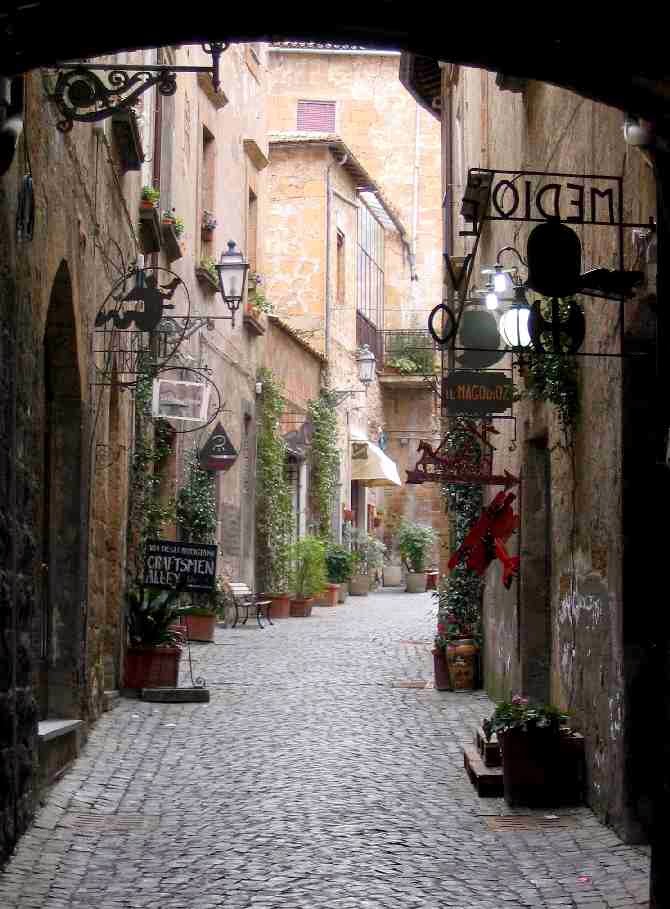
Orvieto
In October 1999, in the Umbrian town of Orvieto, held the first meeting of the representatives of the Italian cities wishing to join the newly formed organization. The coordinator and originator of the idea of ​​cittaslow was the mayor of Greve di Chianti - Paolo Saturnini. The inspiration was for him a philosophy of slowfood, movement created with the aim of  conservation traditional and characteristic for the given region cuisine. Looking at the history of the Italians, who managed to create a common state only in 1861, it is hardly surprising that they are so attached to local tradition and that they desire to protect them.

Poland takes the fourth place in the world in terms of  the number of slow towns. In Warmia and Mazury, where I was born, there are: Reszel, Ryn, Bisztynek, Biskupiec, Olsztynek, Nowe Miasto Lubawskie, Lidzbark Warmiński and Lubawa. By contrast there is only one slowcity in Wielkopolska which not belong to the land of a thousand lakes. It is called Murowana Goślina and it is situated 20 km from Poznań. One of the requirements that the city must meet if it want to join the "International Network of Cities Cittaslow" is a population no exceeding 50,000 of people. 

Reszel

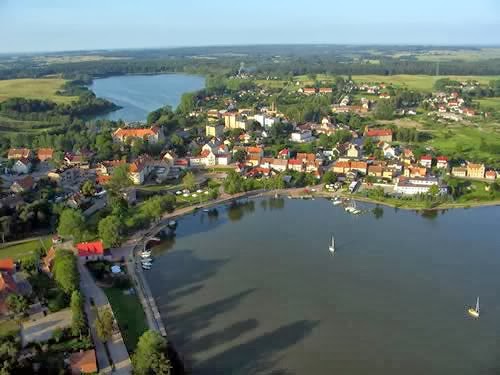
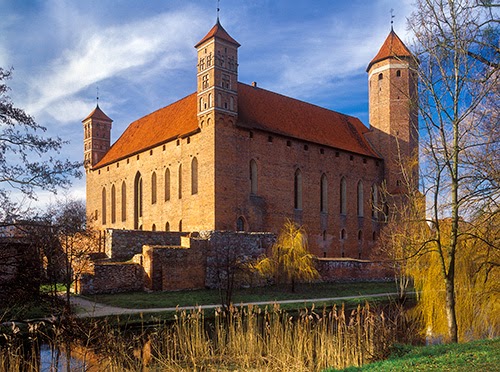
The most fascinating example seems to be Reszel, which is the architectural jewel of Warmia and Mazury. Its inhabitants call it the most beautiful city in the world, and in my opinion they aren't so far from the truth. Reszel is full of historical monuments and unique decorations, such as antique advertising signs or ubiquitous flowers. The city is also interesting because of its history,  there in 1811 burned at the stake last European "witch", Barbara Zdunk. Other cities that deserve attention are also Lidzbark Warminski, where we can admire the well-preserved medieval monuments such as the castle towering over the city with its beautiful cloister and Ryn, which is situated on two lakes. 

I really like this idea of ​​combine tradition with modernity. What do you think about this? Have you ever been in one of the cittaslow in Poland or in Italy? Waiting for your comments :) 


Ryn

Castle in Lidzbark Warmiński